
Forget the “Golden Age of Agile.” That party is over.
We are currently living through the most aggressive inversion of software engineering since the compiler replaced punch cards. If you’re still measuring success by your ability to close Jira tickets or write clean syntax from scratch, you are essentially manually tuning a channel on a transistor radio while the rest of the world is streaming 4K video.
We have moved beyond “tools” and into the era of the AI-Driven Development Life Cycle (AIDLC)—an ecosystem where the machine doesn’t just assist the work; it executes the work.
This leaves the human with the much harder, more terrifying task: Intent.
The Industry Has Already Flipped the Switch
This isn’t my opinion. The market has already voted. The “efficiency gains” aren’t coming; they are here.
Amazon: In a massive internal migration, Amazon Q saved the company 4,500 developer years of effort. This wasn’t a projection—it was a documented reduction in manual labor that saved over **$260 million in immediate annualized costs.
Salesforce: During Cyber Week 2025, Salesforce reported that their “Agentforce” autonomous agents actively influenced $67 billion in global sales. Agents are no longer just answering support tickets; they are closing deals.
GitHub: By July 2025, GitHub Copilot surpassed 20 million active users, with 90% of the Fortune 100 standardization on the tool. The “experiment” phase is officially over.
Gartner: Gartner’s latest outlook is blunt: “By 2026, 80% of software will be built with no-code, low-code, or GenAI tools.” If you are planning to write every line of code by hand in 2026, you are already in the minority.
The “efficiency gains” aren’t coming; they are here. The question is no longer “Will AI write code?” It is “What is left for you to do?”
The Blueprint: From Manual Labor to AI Orchestration
The shift to AIDLC is a total structural collapse of the old siloed factory model. We are moving from a relay race (Handoffs) to a recursive loop (Orchestration).
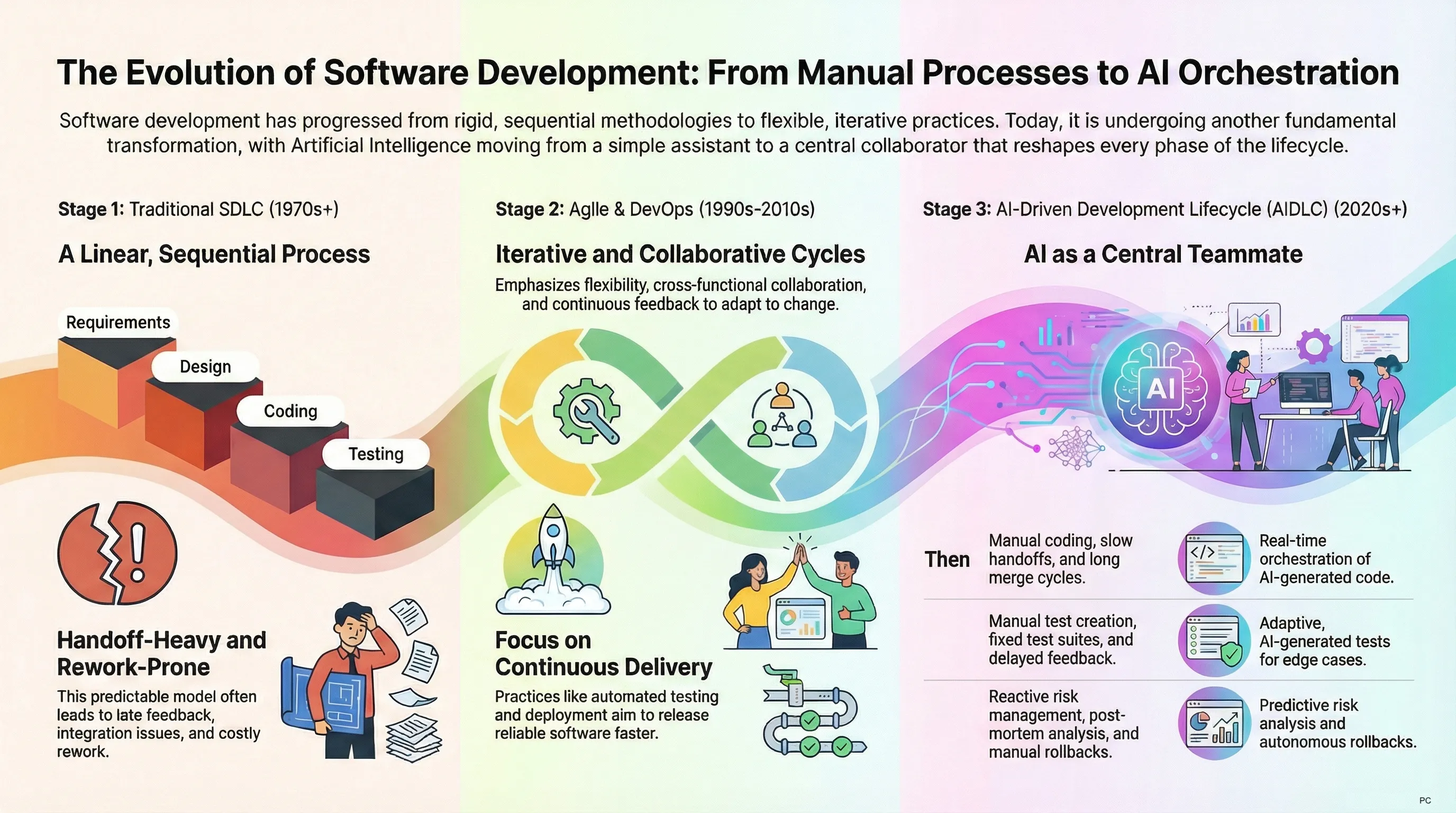
Phase 1: Inception (The Death of Requirements Gathering) We’ve killed the long, boring requirements phase. AWS and others are pioneering “Mob Elaboration,” where humans and AI validate business goals in real-time. You don’t write a spec document; you argue with an agent until it understands the business logic better than you do.
Phase 2: Construction (The End of “Typing”) In the AIDLC, the human doesn’t type code; they steer. The AI proposes the architecture and churns out the syntax. Your job is Governance: steering the AI away from hallucinations and toward system-level stability.
Phase 3: Operations (The Self-Healing System) Deployments are becoming autonomous. The system heals itself. Humans now oversee health from 30,000 feet, acting more like air traffic controllers than mechanics.
The Great Role Migration
In this new world, if you don’t adapt, you become a bottleneck. The “Individual Contributor” is dead. Long live the Orchestrator.
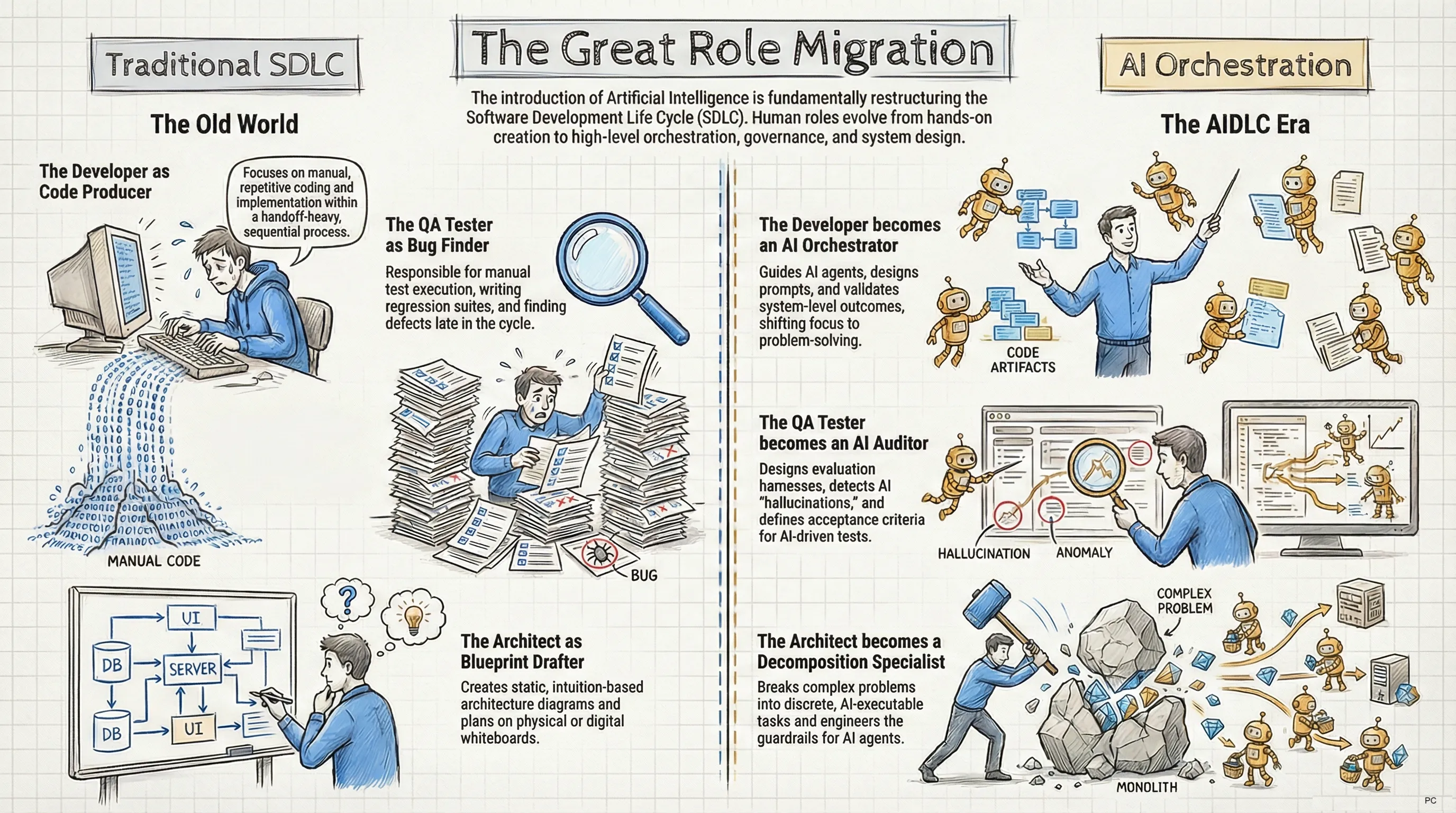
The Developer ➡️ The AI Orchestrator: Your value is no longer your “clickety-clack” typing speed. You are a pilot steering a fleet of agents. You focus on Semantic Precision—if you can’t describe exactly what you want, the AI will build the wrong thing faster than you can imagine.
The QA Tester ➡️ The AI Auditor: Manual execution is over. You are now a semantic detective hunting for logic gaps. You design the evaluation framework that grades the AI.
The Architect ➡️ The Decomposition Specialist: This is the most critical role. AI gets confused by massive, messy problems. The Architect’s new job is breaking down business complexity into discrete, “safe” tasks that an agent can execute without hallucinating.
The Senior Shortage Time Bomb
Here is the uncomfortable truth: AI is elite at entry-level tasks.
Because of this, companies are hiring fewer juniors. This is a disaster in the making. Even AWS CEO Matt Garman recently called the idea of replacing juniors with AI “the dumbest thing I’ve ever heard”—not because AI can’t do the work, but because if we stop training juniors, who becomes the seniors?
We need a New Apprenticeship Model. Juniors must stop being “code monkeys” and start as Apprentice Auditors. They need to learn by critiquing AI output, building their “architectural taste” years earlier than they used to.
The New Math of Engineering
The leverage has shifted forever.
Before AI: 1 Senior + 3 Juniors = Standard Output.
After AI: 1 Senior + 1 AI Assistant = Same Output.
The Near Future: 1 Senior + Advanced AI Agents = The output of a 40-person team.
How to Survive the AIDLC
The winners of this era won’t be the best coders. They will be the ones with Architectural Taste.
You need to know what “good” looks like because the AI won’t always tell you when it’s giving you “AI Slop.” You need Governance by Design—building security and limits into the prompt, not fixing them in the pull request.
💬 Let’s Argue About the AIDLC: If one senior architect can produce the work of 40 people, what happens to the “culture” of a software company? When the “human” element is reduced to pure orchestration, do we lose the serendipity that comes from a messy, collaborative team?
I learn as much from the debate as I do from the documentation.
🌱 Want more experiments? This is just one plant in my digital garden. I’m constantly breaking things, hitting limits, and documenting the fixes over at my personal site.
If you like deep dives into the “Real World” of Enterprise AI (minus the marketing fluff), go check it out:👉 Pavan’s Digital Garden