If you’ve read Episode 1, you probably remember how we opened the door to this new world of AI MCP (Model Context Protocol) — the idea that systems could start reasoning, not just integrating.
It felt exciting, futuristic… maybe too good to be true.
And honestly, that’s what I’ve been thinking about ever since.
Because like most of you who’ve lived through long integration nights, broken APIs, and “mysterious” data mismatches — I’ve learned that every shiny new thing comes with its own set of “gotchas.”
So, in this episode, I want to take a more grounded look.
Let’s unpack how MCP fits (or doesn’t) alongside something we already trust — Integration Services. For this article, I will reference to Mulesoft.
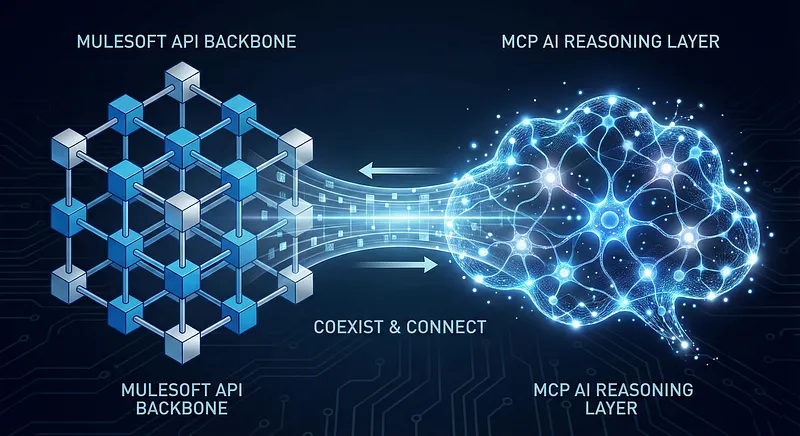
MuleSoft and MCP systems illustrated as interconnected structured and neural networks.
Where We Left Off
In Episode 1, we imagined MCP as the bridge between AI reasoning and enterprise systems — something that lets an AI assistant “understand” your CRM, ERP, and knowledge systems without 100 manual connectors.
Now the question is:
“If MCP connects everything magically, what happens to MuleSoft?”
That was literally my first question too.
After exploring a few prototypes and talking with architects, the answer became clearer — it’s not a replacement story. It’s a partnership story.
They just play different roles in the same orchestra.
Structured Logic vs. Adaptive Reasoning
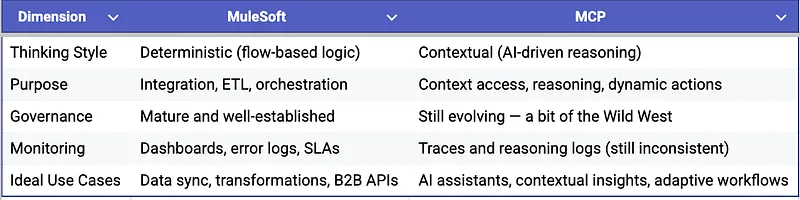
MuleSoft is reliable and deterministic, MCP is adaptive and AI-driven — both have strengths and trade-offs.
You can already sense it — MuleSoft is structure, while MCP is spontaneity.
Both are needed, but not always together — and definitely not without some thought.
When MCP Feels Like Magic (and a Little Risky)
I tried imagining real-world moments where MCP would shine.
Say a sales rep asks an AI assistant:
“Why are my Q3 deals lower than last year?”
Now, with MCP, that assistant can pull from Salesforce opportunities, marketing leads, and even customer sentiment data — all in real time.
No need to wait for an ETL job. It’s reasoning on the fly.
It feels like magic — until it’s not.
Because if your data definitions aren’t consistent, or if the AI picks the wrong context (say, interpreting “closed deals” differently in two systems), the answer might sound confident but be completely wrong.
That’s when you realize — reasoning without governance can be dangerous.
I’ve started seeing this pattern already: MCP needs boundaries, not just access.
So, while it’s great for insights, recommendations, and exploration, I wouldn’t trust it (yet) for structured data sync or compliance-heavy flows.
When MuleSoft Still Has the Upper Hand
Here’s where MuleSoft still quietly saves the day.
Picture your monthly customer data sync — ERP, Salesforce, and a data lake.
You’ve got mappings, validations, transformations, error retries, all running like clockwork.
Now imagine replacing that with an AI reasoning layer that decides when and how to sync based on “context.”
Sounds flexible — but it also sounds like a Friday-night deployment waiting to go wrong. 😅
This is where MuleSoft’s determinism wins.
You know what’s happening.
You can trace it, audit it, control it.
That level of predictability is priceless — especially when your CFO is asking, “Why did the revenue numbers suddenly change in the dashboard?”
The Hybrid Reality: “MuleSoft + MCP = Intelligent Integration Fabric”
The most exciting part, though, is when these two work together.
That’s where I see real potential.
Think of MuleSoft as your trusted integration backbone, exposing clean, secure APIs.
Then, MCP acts as the intelligent front-end that reasons when and why to use those APIs.
For example:
- MuleSoft exposes “Customer Order APIs.”
- MCP consumes them as Tools, calling them only when contextually relevant.
- The AI doesn’t replace the flow — it triggers it intelligently.
Now, instead of data just flowing, it’s thinking while flowing.
That’s the Intelligent Integration Fabric — predictable where it should be, adaptive where it can be.
But It’s Not All Smooth Yet
There are still rough edges.
- Governance models for AI-triggered calls are immature.
- Cost monitoring (especially for AI-based reasoning requests) can get unpredictable.
- And tracing “why” an AI chose a particular API call? That’s still a mystery box.
So I’ve started thinking of MCP as something you layer on carefully — experiment with side-by-side integrations, not mission-critical ones (yet).
Because as exciting as AI orchestration sounds, sometimes a boring, predictable flow is your best friend.
The Road Ahead
As enterprises evolve, I think we’ll start seeing MuleSoft APIs exposed as MCP Tools — a bridge where AI can reason on top of structured integrations.
In that world, MuleSoft remains the “spine,” and MCP becomes the “brain.”
And maybe that’s how we build the next generation of connected, intelligent enterprises — one careful step at a time.
🚀 Next Up
In Episode 3 — “Building an AI-Connected Enterprise with Salesforce and MCP”,
I’ll explore how all of this ties together — from reasoning agents to integration fabrics —
and what it means for architects who are designing the next phase of enterprise intelligence.
Until then, I’ll keep tinkering, testing, and probably breaking a few sandboxes in the process.
Because that’s how we really learn, right?