Recap
We’re deep into our journey now.
In Episode 1, we discovered the “nervous system” of AI (MCP) and in Episode 2, we realized that APIs and MuleSoft aren’t dying—they’re just getting a new boss.
Now, in Episode 3, we arrive at the most critical decision point in this entire architecture. It’s the question every CTO, architect, and developer is debating in Slack channels right now:
“Do I build with the free, open-source community version? Or do I pay for the enterprise-grade version like Salesforce’s Agentforce?”
This isn’t just a tech choice. It’s a philosophy choice.
Today, we break down Open MCP vs. Agentforce MCP—the costs, the architecture, and the “gotchas” nobody tells you about.
🌗 A Tale of Two Protocols
First, let’s be clear: The underlying protocol is the same. Whether you use Anthropic’s open-source SDK or Salesforce’s Agentforce, the JSON messages flying back and forth look identical.
But where they live and who controls them makes all the difference.
1. Open MCP (The “Wild West” Approach)
This is the pure, open-source standard originally championed by Anthropic.
The Vibe: Linux in the 90s. DIY, powerful, and infinitely flexible.
How it works: You run an MCP server (a small script) on your laptop, a Docker container, or an AWS Lambda function. You connect it to any MCP-compliant client (Claude Desktop, Cursor, or your own custom bot).
The Catch: You are the security guard. If you expose your production database via Open MCP and forget to add authentication? That’s on you.
2. Agentforce MCP (The “Walled Garden” Approach)
This is Salesforce’s enterprise wrapper around the standard.
The Vibe: Apple’s App Store. Polished, secure, expensive, and it just works (as long as you stay inside the walls).
How it works: Salesforce acts as the “Host.” You register your MCP tools inside Salesforce. When an agent tries to use a tool, it passes through the Einstein Trust Layer—a security bouncer that checks permissions, masks PII (Personally Identifiable Information), and logs every single action.1
The Catch: You pay for the privilege. And you play by Salesforce’s rules.
🏗️ The Architecture: “USB-C” vs. “The Universal Dock”
I love the “USB-C for AI” analogy, but let’s refine it for the enterprise.
Open MCP is like a bag of USB-C cables. You can plug anything into anything. Want your local Llama 3 model to talk to a PostgreSQL database on your private network? Done.
- Pros: Zero lag, zero license cost, total control.
- Cons: You have to build the plumbing. You handle the retries, the error logging, and the API key management.
Agentforce is like a Thunderbolt Docking Station. It has specific ports. You plug your tool into the “Agentforce” dock, and suddenly:
- It automatically knows who the user is (User Context).
- It respects your Salesforce Sharing Rules (Governance).
- It records an audit trail of what the AI did (Compliance).
The Reality Check:
Open MCP connects systems to models. Agentforce connects business contexts to employees.
💸 The Price of Intelligence (Licensing Reality)
Here is where the rubber meets the road.
Open MCP Pricing:
- Protocol: Free (MIT License).
- Cost Driver: You pay for the Intelligence (OpenAI/Anthropic API tokens) and the Hosting (AWS/Azure bill).
- Hidden Cost: Engineering time. “Free” software is only free if your engineers’ time is worth zero dollars.
Agentforce Pricing:
- Protocol: Included in the platform… technically.
- Cost Driver: You pay via Flex Credits (consumption-based) or high-tier Agentforce User Licenses.
- Example: Roughly $2 per conversation or $0.10 per “action” (depending on your contract) - This is just an example, not actual value
The “Ouch” Factor - If you build a tool that runs a loop 1,000 times a day? That bill adds up fast.
My Take: Open MCP is cheaper for high-volume, low-risk automation. Agentforce is cheaper when you factor in the cost of a data breach.**
🚦 The Decision Matrix: Which One Do You Choose?
Stop guessing. Use this matrix!
| Feature | Choose Open MCP If… | Choose Agentforce MCP If… |
|---|---|---|
| User Base | Tech-savvy devs, internal tools, or public-facing apps outside CRM. | Sales reps, support agents, and employees living inside Salesforce. |
| Data Gravity | Your data lives in AWS, Snowflake, or legacy on-prem DBs. | Your data lives in (or is synced to) Salesforce Data Cloud. |
| Security | You are comfortable managing your own OAuth and firewalls. | You need “Bank-Grade” security compliance out of the box. |
| Budget | Tight OpEx; you have spare engineering capacity. | Larger budget; you need speed-to-market and low maintenance. |
🔮 The Future is Hybrid
Here is the plot twist. You don’t have to pick just one.
Salesforce has quietly made a brilliant move: Agentforce can consume external Open MCP servers.
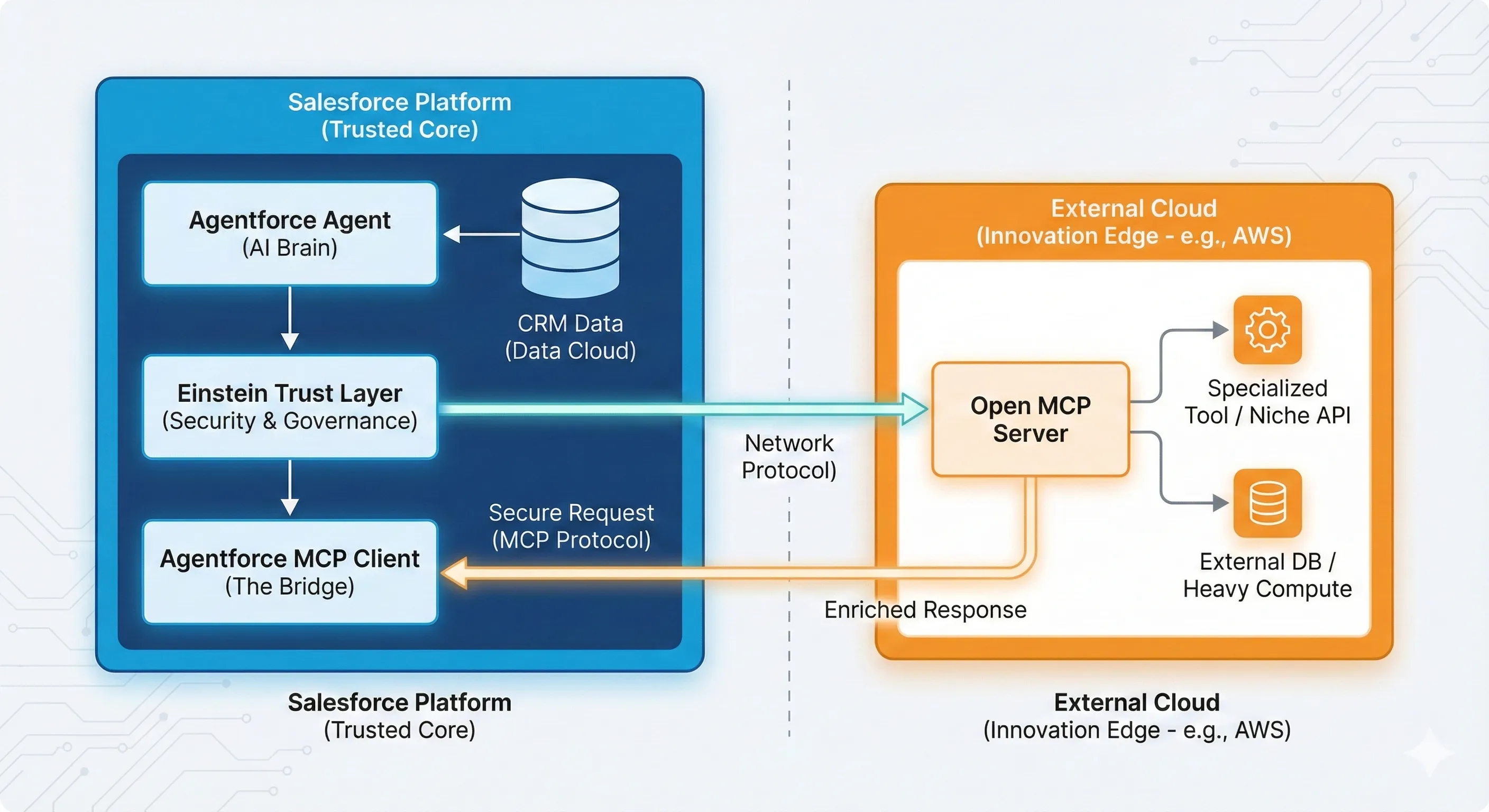
This is the “Hybrid Architecture” we are driving toward:
- The Core: You use Agentforce for your customer-facing agents. They handle the sensitive CRM data, guarded by the Trust Layer.
- The Edge: You build Open MCP servers on AWS/GCP/Azure for your heavy-lifting computation or niche internal tools.
- The Bridge: You register your Open MCP server inside Agentforce.
Your Salesforce Agent can now reach out, use your cheap/custom Open MCP tool, and bring the result back into the secure CRM environment.
⚡ Quick Example: The “Super-Quoter”
The Goal: A sales rep needs a quote combining Salesforce customer data + Live SAP Inventory.
Open Source (The “Sidekick”): The rep runs a Python script on their laptop to fetch data.
- ❌ The Flaw: Fast to build, but the data is stuck on a laptop. It’s Shadow IT.
Agentforce (The “Official”): The rep clicks “Draft Quote” inside Salesforce.
- ❌ The Flaw: Secure, but blind to SAP. It can’t see real-time inventory without heavy integration.
Hybrid (The “Power Move”): The rep asks Agentforce: “Quote 500 units.”
- ✅ The Fix: Agentforce (the Brain) uses a secure MCP tunnel to check SAP (the Tool), then builds the official quote inside Salesforce. Secure + Connected.
👀 The “Gotchas”
Since this is all new, here is where teams usually trip up.
1. The “Token” Trap (Security Risk)
The Fear: In Open Source MCP, your “server” often holds the keys to the kingdom (API keys for Google Drive, Slack, etc.).
What Goes Wrong: If you run an MCP server on your laptop and a malicious website or a “jailbroken” AI prompts it correctly, it could theoretically ask your server to “Delete all files.”
The Learning: Never connect a “God Mode” MCP server to an AI without a “Human in the Loop” confirmation step for dangerous actions (like deleting data).
2. The “Timeout” Problem (Latency)
The Fear: AI takes time to think. External tools take time to load.
What Goes Wrong: Salesforce has strict time limits (often 10-60 seconds for transactions). If your Hybrid MCP server is running a slow Python script to analyze a PDF, Salesforce might just “hang up” the phone before the answer is ready.
The Learning: For heavy tasks, don’t make the user wait. Have the AI say, “I’m working on that, I’ll ping you when it’s done,” and run the job asynchronously.
3. The “Hidden” Maintenance Cost
The Fear: Open Source is “free” like a puppy is free.
What Goes Wrong: You build a custom MCP server to talk to your internal SQL database. It works great… until the database password changes, or the server runs out of memory, or the AI model updates and stops understanding your tool definitions.
The Learning: Only build your own Open Source MCP servers if you have an engineering team ready to patch and maintain them forever. Otherwise, pay for the Agentforce version.
✨ Closing Thought
The war isn’t “Open vs. Closed.” The winner will be the architect who knows when to pay for the guardrails and when to run wild in the open fields.
We’ve now covered the What (Ep 1), the How (Ep 2), and the Which (Ep 3). But this is where the technology discussion ends, and the transformation discussion begins.
👇 Coming Next
Episode 4: From “iPaaS” to “iBrain” — We are entering an era where we stop writing integration flows and start defining outcomes. In the grand finale, we explore what happens when the integration wiring starts to think for itself.
💬 Let’s Make This a Conversation
This fork in the road is where teams often get stuck.
- Are you Team Open Source (DIY)?
- Or Team Enterprise (Agentforce)?
- Or are you brave enough to try the Hybrid bridge?
Let me know in the comments—I’d love to hear which route you’re taking!