Have you ever asked your smart speaker to “Play my Morning Focus playlist on Spotify,” only to have it confidently blast a random death metal mix at 7:00 AM?
If you rely on Google Home or Alexa for your daily routines, you already know the dirty little secret of modern IoT: the “smart” part is often just a cloud algorithm guessing what you want.
The “Real Talk” Architecture: Local Control, Deterministic Execution
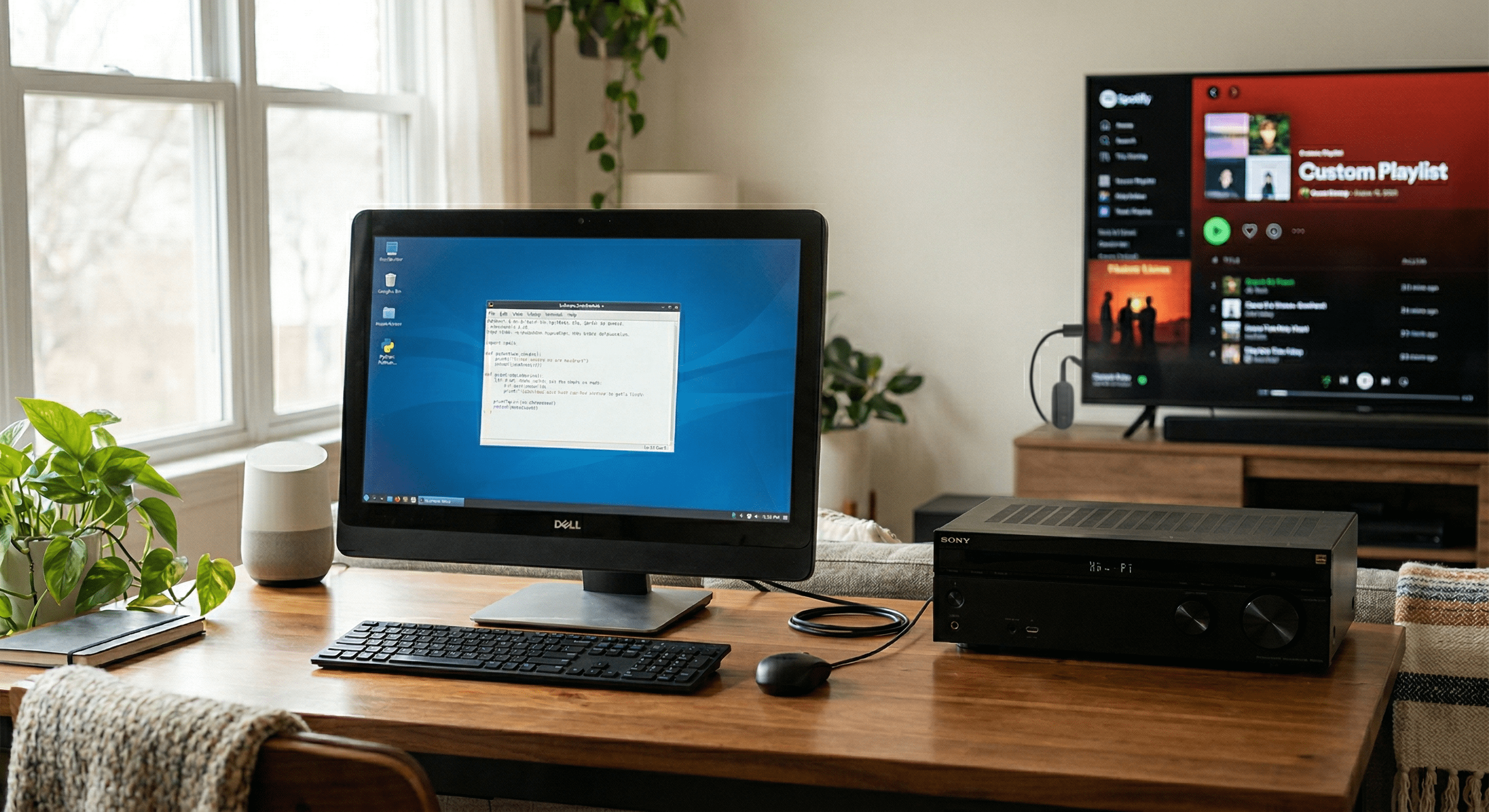
Before we get into the step-by-step story of my struggle, let’s talk about the solution. What I built is simple: I declared independence from the cloud for this specific routine. I took an old, dormant desktop and turned it into a headless, local-first automation server.
I gave it a brain that sleeps and wakes up on a schedule, an execution layer that speaks directly to APIs instead of guessing from text, and a transport system that uses a $50 dongle to wake up a massive, high-fidelity audio system. No “smart” magic. Just hard-coded, deterministic engineering.
My Struggle: The Problem with NLP Guesswork
My struggle started with a deceptively simple goal. At exactly 7:31 AM every day, I wanted my receiver to wake up and play a highly specific, custom playlist. Sounds easy. Just throw a text command into a native Google Home Routine and walk away, right?
Wrong.
Every other day, it would break. Because native routines rely entirely on Natural Language Processing (NLP), you are essentially throwing text into an algorithmic void. If Spotify’s search weighting shifted slightly, or if someone else created a public playlist with a similar name, the cloud got confused. I don’t want an automation that guesses. I wanted a machine that executes. Dealing with this lack of deterministic execution was infuriating. So, I ripped the consumer-grade cloud entirely out of the equation.
I’ve been running this custom edge server in my “production” environment for months now, and it hasn’t missed a single beat. Here is exactly how I built it.
The Story: Step-by-Step Execution
1. The Brain: Repurposing Old Hardware with rtcwake
You don’t need a massive server rack to run local automations; an old PC works perfectly. However, leaving a legacy desktop on 24/7 is a massive waste of electricity.
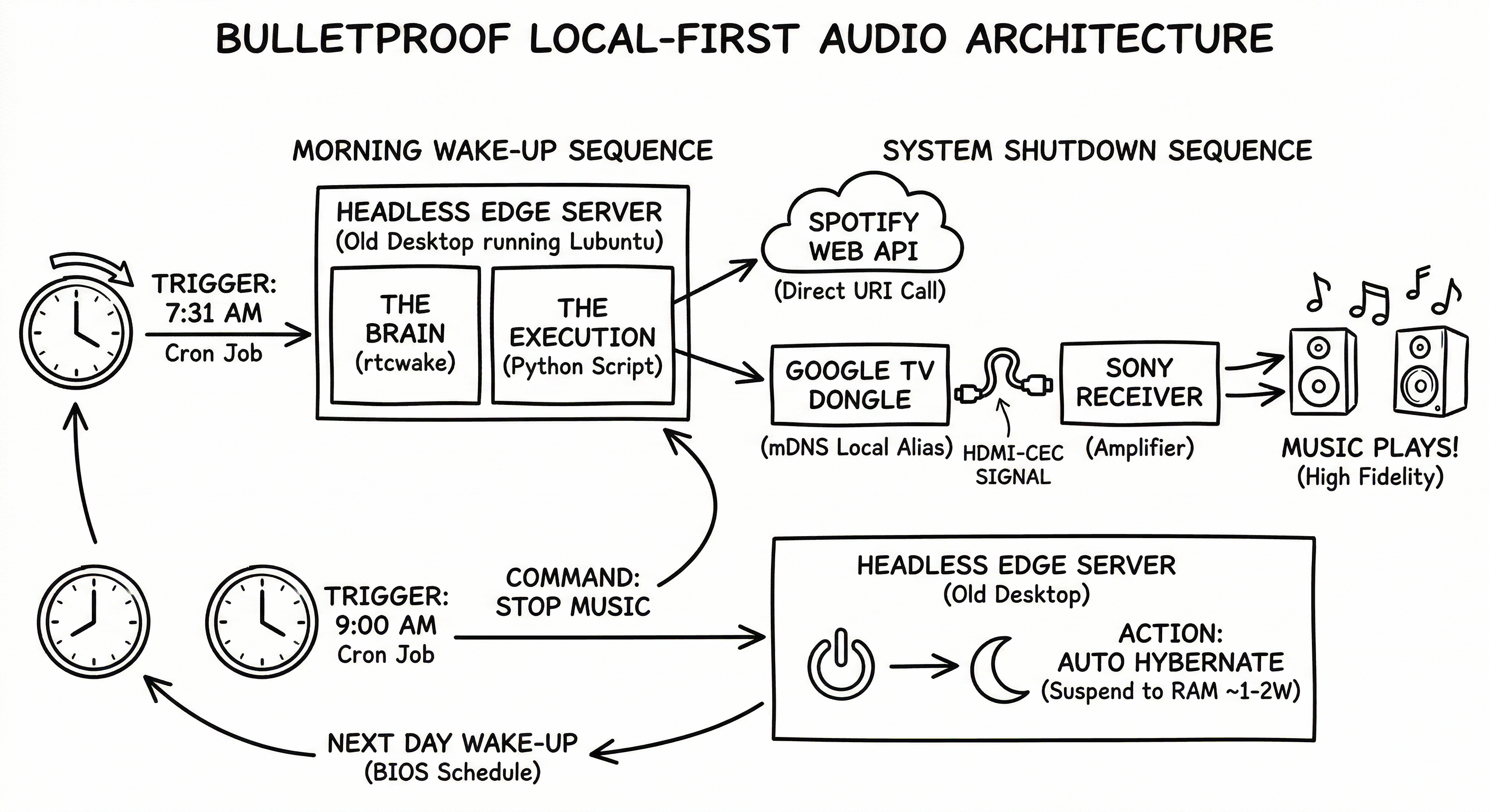
To solve this, I utilized Linux’s native rtcwake command in a cron job. After the morning routine finishes, the machine automatically suspends to RAM, drawing roughly 1-2 watts of power. At 7:20 AM the next day, the BIOS natively wakes the machine up. It’s power-efficient, self-healing, and highly reliable.
2. The Execution: Python + The Spotify Web API
Instead of relying on Google Assistant to search for a playlist name, the Lubuntu machine runs a lightweight Python script using the spotipy library.
By passing the exact Spotify URI for the day’s playlist directly to the API, we eliminate the NLP guessing game entirely. It is a direct, deterministic API call to Spotify’s backend.
Bonus: The local hard drive natively handles the OAuth caching. If you have ever tried to manage stateless refresh tokens in a cloud function, you know what a massive headache this local caching eliminates.
3. The Transport: Google TV + HDMI-CEC
Rather than dealing with flaky Bluetooth connections from the old PC to a receiver, the Python script targets a Google TV dongle sitting on the local network.
The dongle is plugged directly into a Sony receiver with HDMI-CEC enabled. When the Python script pings the dongle at 7:31 AM, the dongle wakes up, shoots the CEC signal down the HDMI cord, turns on the massive receiver, and starts blasting the music in high fidelity. No “smart plugs” required.
The Takeaway
There is a profound satisfaction in reclaiming old hardware to build something robust.
By pulling the execution logic out of the unpredictable Google cloud and putting it onto a repurposed local Linux machine, the architecture is now strictly deterministic. The hardware power-cycles itself, the tokens self-refresh locally, and the execution relies on hardcoded URIs instead of voice-assistant guesswork.
Sometimes, the most scalable and reliable technology isn’t a shiny new SaaS platform. It’s a 10-year-old desktop running a perfectly timed cron job.